
Short description of the Faculty
Faculty
The Faculty of Humanities, Social Sciences, and Theology faces the societal challenges of the present and the future with its research.
With about 10,000 students, it is one of the three major faculties of the FAU. Its research and teaching focuses on the humanities, social sciences and religion-related sciences. A specific feature is the responsibility of all departments within the faculty for teacher education.
Homepage of the faculty: www.phil.fau.de (in German)
Mission Statement of the Faculty: www.phil.fau.de/leitbild (in German)
Research
Research at the faculty takes place both individually and collaboratively. Key research priorities have been established to promote (inter-) disciplinary collaborative research.
In addition, interdisciplinary cooperation in interdisciplinary centers (IZ) and central institutes (ZI) is institutionalised.
Current research projects can be found at: www.phil.fau.de/projekte (in German)
An overview of publications can be found at: www.phil.fau.de/publikationen (in German)
Teaching and studying
Due to the wide range of disciplines, the faculty offers a great many degree programmes. In the bachelor programme, most of the subjects are studied in an almost freely selectable combination of two subjects (so-called “two-subject Bachelor”). The Master’s programmes follow either a disciplinary or a decidedly interdisciplinary approach. In addition, the faculty plays a significant role in FAU teacher training programmes. The course offer is partly supplemented by continuing education programmes.
Overview of the courses offered by the Faculty: www.phil.fau.de/studienangebot (in German only)
The faculty in the region
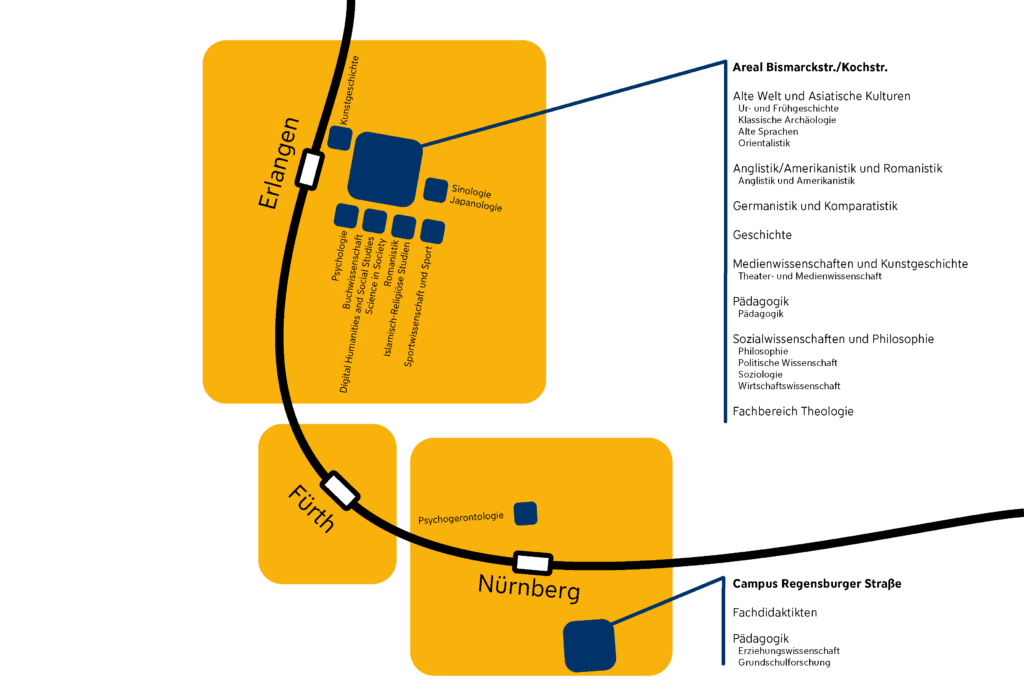
The faculty is particularly marked by its professional diversity, which is reflected in the twelve departments, which are often divided into institutes. The facilities of the faculty are spread over locations in Erlangen and Nuremberg.
The faculty in numbers
Students: about 10,000
Professors: approx. 140
Scientific staff: about 500
Non-scientific Staff: about 100
Bachelor programmes: 36
Master programmes: 41
Teacher training subjects: 21
Third-party funding per year: approx. € 20 million
Departments: 13